Victron LFP-Smart 12.8/100

Victron LFP-Smart 12.8/100

Availability
In stock
Number of offers: 2
Minimum order
1 pcs
Incoterms
CIF, EXW, FCA

Net price by quantity

from 497.23 €

Quantity-tier prices are visible to registered companies.

No payment now. Transport is quoted after you place the order and needs your approval.
Description

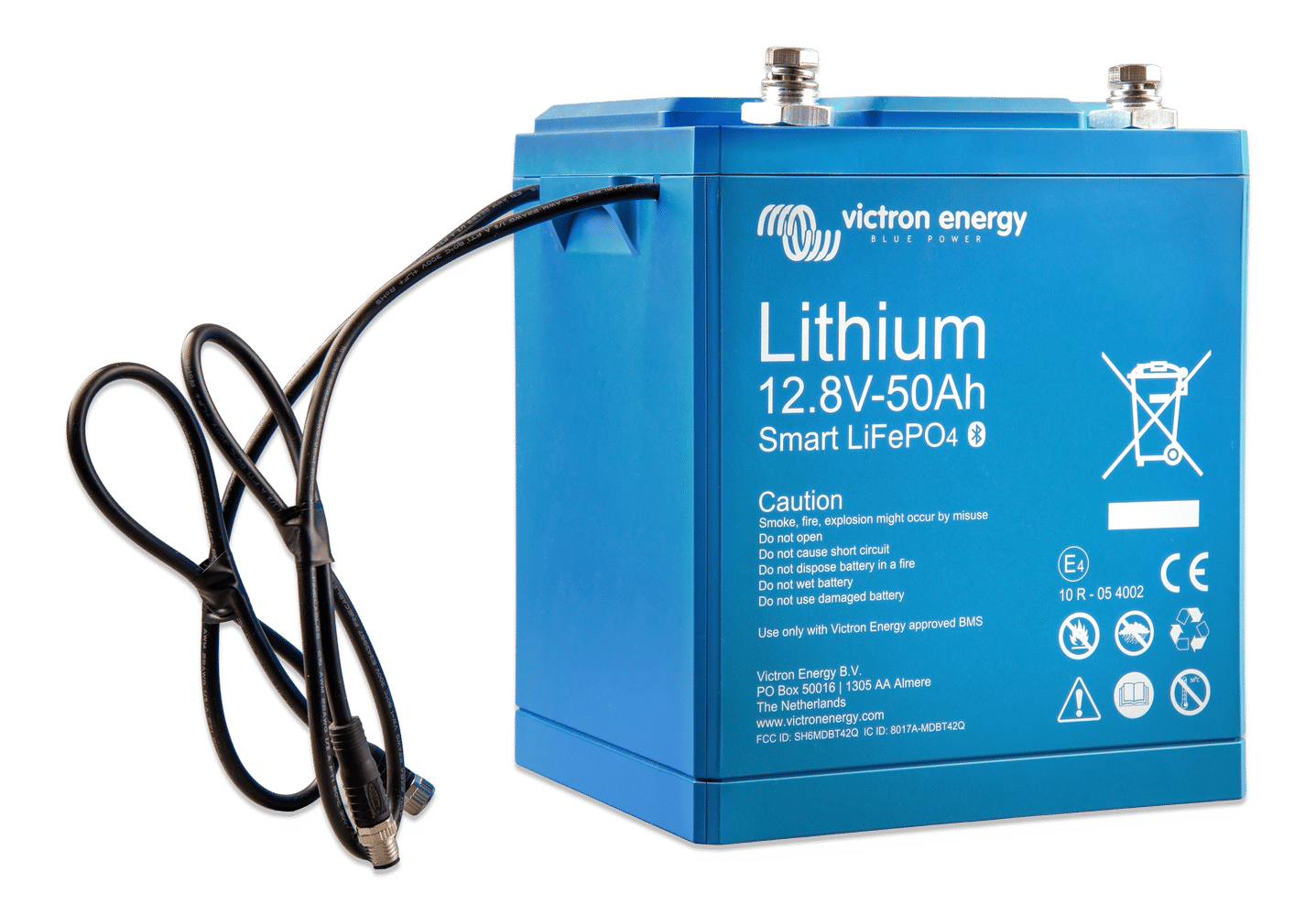
Battery Victron LFP-Smart 12.8/100 with 100 Ah capacity, LiFePO4 (LFP), voltage 12.8 V. Dimensions 197 × 321 × 152 mm (H × W × D), weight 15 kg.

Manufacturer information

Victron Energy Lithium Battery Smart batteries are Lithium Iron Phosphate (LiFePO4) batteries and are available in 12.8 V or 25.6 V in various capacities. They can be connected in series, parallel and series/parallel so that a battery bank can be built for system voltages of 12 V, 24 V or 48 V. The maximum number of batteries in one system is 20, which results in a maximum energy storage of 84 kWh in a 12 V system and up to 102 kWh in a 24 V1) and 48 V1) system. A single LFP cell has a nominal voltage of 3.2V. A 12.8 V battery consists of 4 cells connected in series and a 25.6 V battery consists of 8 cells connected in series. Why lithium-iron-phosphate? Rugged A lead-acid battery will fail prematurely due to sulfation: • If it operates in deficit mode during long periods of time (i.e. if the battery is rarely, or never at all, fully charged). • If it is left partially charged or worse, fully discharged (yacht or mobile home during wintertime). A LFP battery: • Does not need to be fully charged. Service life even slightly improves in case of partial charge instead of a full charge. This is a major advantage of LFP compared to lead-acid. • Other advantages are the wide operating temperature range, excellent cycling performance, low internal resistance and high efficiency (see below). LFP is therefore the chemistry of choice for demanding applications. Efficient • In several applications (especially off-grid solar and/or wind), energy efficiency can be of crucial importance. • The round-trip energy efficiency (discharge from 100 % to 0 % and back to 100 % charged) of the average lead-acid battery is 80 %. • The round-trip energy efficiency of a LFP battery is 92 %. • The charge process of lead-acid batteries becomes particularly inefficient when the 80 % state of charge has been reached, resulting in efficiencies of 50 % or even less in solar systems where several days of reserve energy is required (battery operating in 70 % to 100 % charged state). • In contrast, a LFP battery will still achieve 90 % efficiency under shallow discharge conditions. Size and weight • Saves up to 70 % in space • Saves up to 70 % in weight Expensive? • LFP batteries are expensive when compared to lead-acid. But in demanding applications, the high initial cost will be more than compensated by longer service life, superior reliability and excellent efficiency. Bluetooth • With Bluetooth cell voltages, temperature and alarm status can be monitored. • Instant readout: The VictronConnect App can display the most important data on the Device list page without the need to connect to the product. • Very useful to localize a (potential) problem, such as cell imbalance. 1) To reduce required balancing time, we recommend to use a little different batteries in series as possible for the application. 24 V systems are best built using 24 V batteries. And 48 V systems are best built using two 24 V batteries in series. While the alternative, four 12 V batteries in series, will work, it will require more periodic balancing time.

Technical data

Product details

Series12,8 & 25,6 Volt Lithium-Iron-Phosphate Batteries Smart

Main parameters

Capacity100 Ah
Battery voltage12.8 V
Cell technologyLiFePO4 (LFP)

Dimensions and weight

Height197 mm
Width321 mm
Length152 mm
Weight15 kg